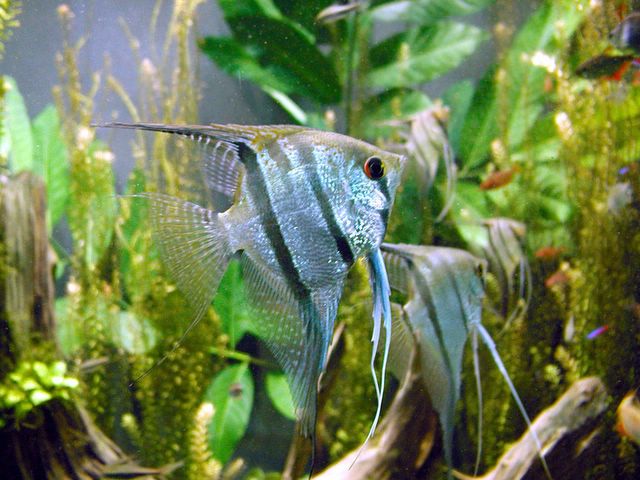
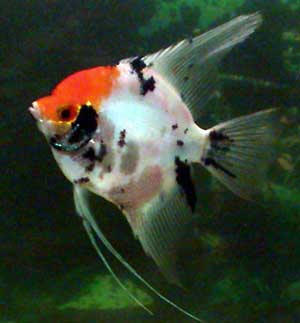
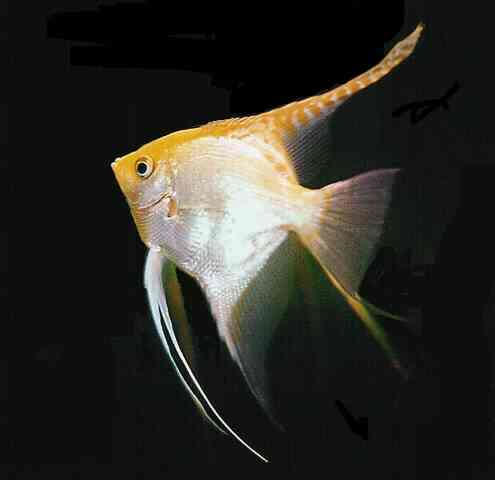
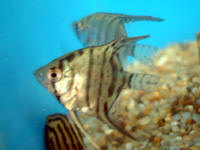
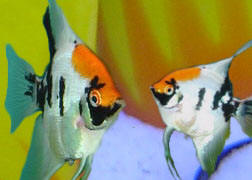
Description: Angel fish basically have disk-shaped,rounded bodies. Angelfish also have elongated dorsal and Anal fins. The Pectoral fins are stretched into long filaments. The Caudal fin is fan shaped and broad. The outermost fin rays are elongated. In some older angelfish the forehead may form a slight hump. Habitat/Care: Live plants should be included in all freshwater tanks. Water quality is monitored by live plants as they will look sickly before the fish die, they aid in keeping water clear, hinder growth of algae and add Oxygen to the water. Broadleaf aquatic plants are favorites of Angelfish for laying their eggs on. Mixing with other fishes: Angelfish seems to have acquired a poor reputation for chasing and eating smaller fish. Until they are about 7cm (2.8in long) they are relatively harmless, and are quite peaceful. As they grow bigger, they tend to prey on smaller fish. Diet: Angelfish can survive on flake food alone, but they will thrive and be much more apt to breed on a greatly varied diet. Live foods such as Adult Brine Shrimp, Black Worms, Mosquito larvae, finely chopped earthworms and Guppy fry are accepted with enthusiasm and should be included regularly. If live food is not available, frozen packages of Blood Worms (Midge Fly larvae), Brine Shrimp and others are available from your favorite pet supply store and are acceptable substitutions for the live food. There are many dried foods available that will suffice too. Raw beef heart, finely ground, mixed with unflavored gelatin and frozen immediately in small one serving size pieces is a good and economical addition to your Angelfish diet. Be absolutely sure there is no fat in the meat. Breeding: Angels are not by any stretch of the imagination easy to sex. The best way to sex them is to let them pair off on their own. Keep about six or eight in a large tank and they will do the rest. A 20 gallon high tank is perfect for breeding pairs of angels. They will spawn on the floor of a tank, in a large flowerpot or on the leaves of a broad leaf plant. However, the preferred method is to put a piece of slate about 3 inches wide and 8-10 inches long leaning at about a 45-50 degree angle in the tank. They will pick at the slate until it is clean and then lay their eggs. Angels’ will lay from 100 to 500 eggs at a time, maybe more. Angelfish will readily lay eggs, but hatching them to grow is a lot more difficult. Immature breeding pairs often eat their eggs within 24 hours; you need to to remove eggs to a separate breeding tank after spawning. Treat the eggs for fungus and supply plenty of aeration, and the eggs will hatch. If you are fortunate enough to get a pair of adults, you will find that once the eggs are laid, both parents take turns in fanning the eggs. This helps to prevent waste materials from settling on the eggs and fungus growth. Sometimes an adult will eat an infected egg, so that it does not affect the other egg. Both sexes will guard the eggs AND the fry. | 







 Posts
Posts


No comments:
Post a Comment