Monday, July 10, 2006

Blood Parrots

This post is specially dedicated to my colleague Keng Soon,whose love for this speices of fish prompted me to find out more.


Data Sheet

Scientific Name: None
Family: Cichlidae
Origin:Crossbred, not available naturally
Adult Size:8 (20cm)
Social:Peaceful fish, but territorial
Lifespan:10 years
Tank Level: All levels

Minimum Tank Size:20 gallons (young) -50 gallons (adult)
Diet:Omnivore
Breeding:Egg Layer
Care:Easy-medium
Ideal pH: 6.5-7.0
Temperature: 72-82 F (22 - 28 C)
Tank setup:

Some rocks and places to hide is preferred
Sexing:Not Known. Sorry


Description:

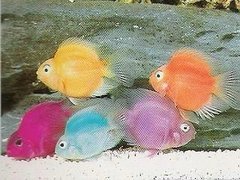
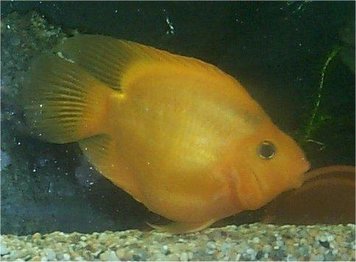
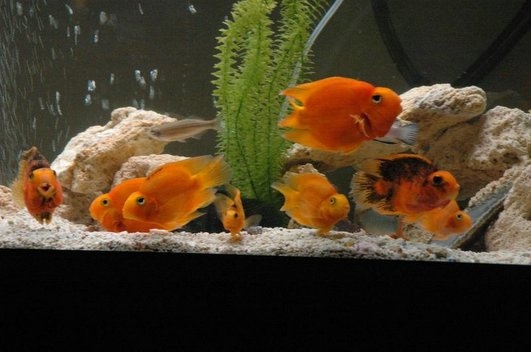
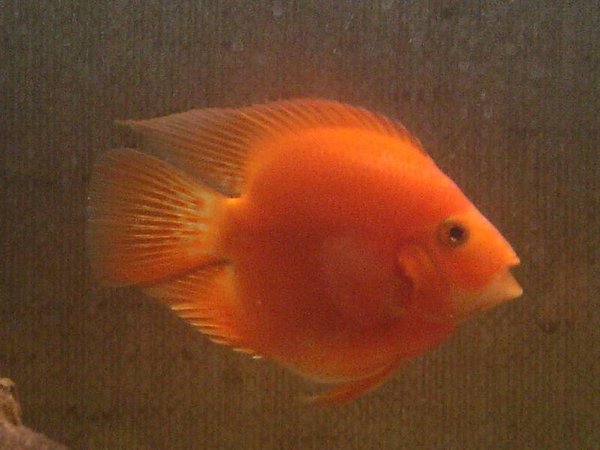
The Blood Parrot is a brightly colored, odd shaped Cichlid. As its name suggests, the fish has a red body and a mouth that resembles a beak. These fish somewhat resemble fancy goldfish and appear to swim awkwardly due to their deformed swim bladders.


Habitat/Care:

Blood Parrots like an aquarium with lots of rock formations and caves for retreating and hiding. Their habitat should be roomy and provide plenty of hiding places, so they can set up their own territory. Rocks, driftwood, and clay pots on their sides are good options. Like other cichlids they will dig in the gravel, so choose a substrate that is not too rough. Plants are not essential though they do not harm them.

Mixing with other fishes:


The blood parrot is a cross-bred from cichlids parents, and you would expect these fish to be highly territorial and aggressive. However, these fish are surprisingly shy and peaceful - and many owners have successfully kept them in a community tank with other mid-size fish such as danios, angelfish, and catfishes. However, true to their parents' heritage, these fishes can be highly territorial and may fight with their tank mates if kept in a community tank.

If these fishes are kept with other cichlids, care should be taken to ensure that their tank mates are not overly-aggressive.

Diet:


Since they are omnivorous, the Blood Parrot will generally eat all kinds of live, fresh, and flake foods. Flake food or pellets are recommended as these food usually contains a mixture of vegetables and meat. Brine shrimp (either live or frozen) or Blood worms can be given to them as a treat.

When the parrots are bigger, they begin to prey on smaller fish, such as guppies, neon tetras etc.

Breeding:

The Blood Parrot, Bloody Parrot, or Blood Parrotfish have been known to breed but most often their eggs are infertile unless they are paired with a non-hybrid fish. I am unable to find out more about breeding blood parrots at the moment, but will endeavor to do so.

Photo Galley


Got a photo? Contact me.


Reader's Pet


Here is a contribution from a reader name Levah Lightfoot.


I've read many comments on this website about blood parrots. I've laughed with what was said about some of them and the things they do. Well here I am writing about our blood parrot, "Angelina", she is so much fun to watch and boy! does she have character plus!!! We have 9 grandchildren, when they come they go to see "Angelina", she seems to know them or at least she always comes to the front of the tank and watches them. She will follow their finger accross the front of the tank. If anyone is in the room she is always at the front of the tank looking at them. When we watch T.V. at night, her feeding time she won't stop looking at us until she gets her food. Now she is the leader of the tank, she lives with four Silver Dollars, two Ballah Sharks, one small catfish and a very large algea fish. When she eats she gets what she wants and they all get the rest, they chase each other for food BUT no one chases "Angelina". It's so much fun to watch her and she seems to like it when you put your hands or arm in the tank, she will rub your hand or arm as if to say, "Hello!". We have a large German Shephard, if you ask her , "where is Angelina?" she will run to the tank and look and "Angelina" will come to the front of the tank and look at the dog. Crazy yes!

Angelina in a PotAngelina outside pot
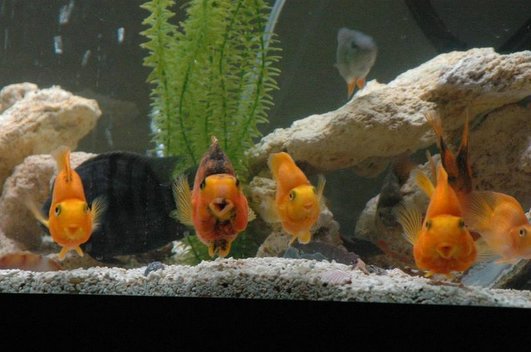
Angelina with Ballah SharkAngelina with Silver Dollars

References Cited:

1. Shirile Sharpe, [Online], Available http://freshaquarium.about.com/cs/livebearers2/p/redtuxedo.htm
2. Shirile Sharpe, [Online], Available http://freshaquarium.about.com/cs/cichlids1/a/bloodparrot.htm
3.
David Brough, [Online], Available http://animal-world.com/encyclo/fresh/cichlid/blparrot.php
4. Micheal McWin [Online], Available
http://www.aquariacentral.com/fishinfo/fresh/bparrot.shtml

22 comments:

Sank said...

Uh. Frankenfish, developed by mad scientists in Taiwan is what I hear. I've heard that there are two different crosses out there. One of them has fertile eggs about 50% of the time. Rumor is a cross between a severum and a red devil cichlid.

I would say, people should avoid the dyed ones. Dyeing fish is often cruel...

Still, good posting Eugine. You do a nice service on this website.

Alex-san said...

Hi Eugene like the blog,
apparently Blood Parrots are bred by crossing a male Midas cichlid(cichlasoma citrinellum) with a female Redhead cichlid(cichlasoma synspilum)but it might not be this straight forward.
Many people think they are freaks and shouldn't be produced, but I think as long as they are healthy and not artificially coloured then people that want to shouldn't be stopped from buying them.
How about a post on Corydoras?
Keep up the good work Alex-san.
www.koi-carp.blogspot.com

george said...

i've going to many web sites to better understand the blood parrot, and I've noticed that many people are against 'creation' of this fish. what I would like to know is want is the big deal? Many people have cross breed dogs, cats, even people are of mixed races. I would advice these "Blood parrot protesters" to try taking care of one, and develop a deeper understanding for these fishes.

These are one of my favourite fishes, along with goldfish,and bettas. I would also say to them, 'nothing that's alive is a mistake.

Carl said...

These have been a popular fish with many of my clients. Also this hybrid can have different strains. For instance the Jelly Bean Parrot has more convict cichlid in them an many of these Jelly Bean Cichlids have bred in the tanks I have maintained.
Other cichlids considered to be in the Blood Parrot line are Red Devils (although the personality does not show) and the severum.


I have written about Blood Parots in my blog: Aquarium Answers; Blood Parrots/ Flowerhorns

Anonymous said...

Cool fish. I love them when they are natural color. I think they shouldn't allow to sell dyed ones that's so mean, im definitely against it, and they look to artificial anyway.

Anonymous said...

We have four oscars, a blood parrot and bottom feeders to keep the tank clean. We keep them in a 125gal tank and have kept them for almost three years. The blood parrot does love to hide out in little hide away places. However it (lucy) gets along great with everyone in the tank. She even fights the big (14" oscar) for food. I think it being right or wrong to breed for these fish is really in the eye of the beholder. Plus if you introduce the fish to a new tank at the same time they are less likely to be agressive as there is no astablished territory. Ours all get along wonderfully. I agree with george that anything living is not to be thought of a mistake, just take care of it or don't buy one. Get over yourselfs.

goiter said...

i have a blood red parrot it has white sores on his face and nose outlet is not ich have already treated for that any helpfull feedback would be great please respond to sinto@comcast.net thank you

Annie said...

I have two blood parrots and they are very nice fish. One of them can be a little aggressive at times, but nothing serious and nothing the other fish are harmed by. I have found that they are very sensitive to temperature and their attitudes change drastically depending on the degrees the tank is at.

Anonymous said...

Just found this site...thanks, informative and interesting. I have four blood parrots and love them to death. They all have different personalities and so far no agression to speak of. I would recommend anyone who has these fish or is interested in them go to parrotcichlid.com for a wealth of information. The folks there are very nice and informative and love these fish.

Amanda said...

My father and I have just recentely gotten back into fish tanks again after many years. We started out with a 29gal and three months later I bought that from him so he could upgrade to a 55gal. We had always looked at the blood parrots and loved their colors but never bought one because we were afraid they would eat/kill out community fish. My father was so interested he decided to look them up on-line and found they had a very nice tempor. So that afternoon we went to our family pet store and picked a bright blue one out on the condision we could bring it back if he started to kill our other fish. It ended up being a very, very frendly fish and I soon bought another one, an orange one for his tank. As soon as we put him in our other blood parrot light up like we have never seen him before. They just love each other and go nuts chasing each other around the tank. They had so much personality that they even gotten names too. "Big Blue" and "Sunburst." Big Blue is far more shy than Sunburst. They both come to the front of the tank when you walk in front of it or whatnot but if you put your hand up to the glass, Big Blue swims away while Sunburst turns to her side as if she wants you to pet her. My father even has them trained to take pellets right out of his hand when he feeds them.

All in all these are very nice fish and I would enjoy getting more someday. But I would most deffently get them in twos seeing how they are much active in groups.

Thomas said...

www.bloodparrots.co.uk

Anonymous said...

I have two blood parrots. I did not know what sex they were. Until 5 days ago, when I saw eggs stuck on the side of a rock. Both of the fish are protecting the eggs. Chasing away the other fish, and taking turns eating. The eggs are changing from a milky color to solid white. I dont know what to exspect. I cant find any literature about breeding parrots. Does any one know about parrot breeding? how long does it take for eggs to hatch?

Yu-Jin Lim said...

Wow, accordingly to some literature, the blood parrots' eggs can be infertile... i.e. they may not hatch. But some readers seem to have success in breeding blood parrots..

Good luck.

Regards,

Eugene.

Genki Rocket said...

Hi.... I set up a forum specifically to help people care for and understand these fish.... I realise they are not everyone's taste though...

Check out my site

http://www.bloodparrotforum.com

||||||| ||||||| ||||||| ||||||| ||||||| ||||||| ||||||| ||||||| ||||||| ||||||| ||||||| ||||||| |||||||

Anonymous said...

I have 3 blood parrots, a very light orange/albino, a darker bright orange, and a blue. They all seem to be very friendly with each other. They chase each other around the tank in a playful manner. They are also relatively easy to care for as well.

Anonymous said...

I have a a beautiful parrot, approximately 7" and bright orange. I've noticed he "sleeps" when there's no light. He has burrowed a spot in the tank. Whenever I come in the room when it's pitch black I will find him resting on his belly in his burrow and his eyes seem to be sunk in, indicating what it looks like to me is sadness. Whenever this happens I nudge him gently with the net and after a few moments, he starts becoming himself again. I think that maybe BPs shouldn't be left in complete darkness, a little light should always be on, whether a bedroom or display aquarium.

Anonymous said...

There is one thing you are missing about these blood parrots. Only a true owner of these fishes know this. So here it goes, when PH of the tank water that the parrot fishes are living in, shoots down to 6.0 or below, no matter what, these fishes gets these white pots on them, its kind of like fungus, but it can be treated with just a water change and make your PH higher. Best way to keep these white spots away from these fishes is have a stable 7.0 PH.

Anonymous said...

A lot of fish in pet stores are genetically created. Same with many Ball Python snakes, dogs, cats, etc. Anyone against hybrid fish should be against keeping fish in a tank at all, because they are out of their natural habitat.

will said...

mine is 15 and still kickin

Jennifer said...

I recently got my first blood parrot, I absolutely loved them in the pet store, and got him or her, home and in the tank. I realized my other Cichlid was too rough on the parrot so I removed the cichlid as he belonged to a friend anyways. I've noticed that my parrot has been hiding by my rock display and laying on his side just under the rock. I really have to hunt to find him because it's such good hiding spot. Has anyone heard of them laying on their sides especially as young fish? and if this is a normal activity for the breed, and if so, how can I get it to be more active?

There are plenty of things for him/her to do in the tank as I have a huge rock display (where he is currently hiding) I have a smaller rock where he can swim threw a hole I have 4 plants and a piece of drift wood. I did my research and knew that the liked to have things to play around or hide and the more they have to hide the more social they should be. Any help or advice would be welcome.

ajay said...

your parrot fish has a black spot it means that it is stressed.blood parrots shouldn't be kept with ballah sharks they should be kept with angel fish,flecos,etc.

Trisha Hartrum said...

I myself have two parrots and no they aren't some funky color. Just orange. They are the best fish I have ever had. Full of personality and smart too. There is one I take care of at work as well and it has been my kissing lil friend for the last 7 years. And is a hit with both children and adults. If you are looking for a fish this is a great one to get just do your homework first. They can't just go into a tank with any old fish and also they prefer a well maintained tank and nice warm water. Also love some bloodworms as a snack. Keep up with the environment of the tank and you will have no problems. :-) love my lil babies