Monday, April 03, 2006

Arowana


Data Sheet

Scientific Name: Scleropages Formosus
Other Names: Arawana, Dragon Fish
Family: Osteoglossidae
Origin: Asia, Australia, Africa,
Adult Size: 90cm (55-58 inches)
Social: Predatory fish that will eat up smaller fishes. Highly territorial
Lifespan: 10-20 years.
Tank Level: mid-top dweller.

Minimum Tank Size: At least 3 times the width of your Arowana, and width same as Arowana length.
Diet:
Eats anything - live crickets, tapdoles, small frogs, small fishes, shrimps etc.
Breeding: Mouthbrooder
Care: Easy - Hardly fish
Ideal pH: 6.5-7
Temperature: 75-85 F (24-29C)
Tank setup: No plants or rocks recommended as this fish needs lots of space and plants and rocks may get in their way.

Sexing:
The male's mouth is wider and deeper.


Description:

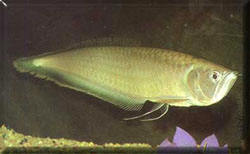
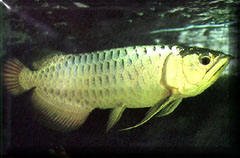
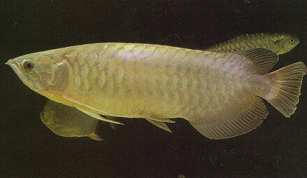
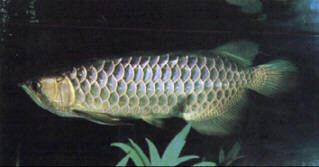
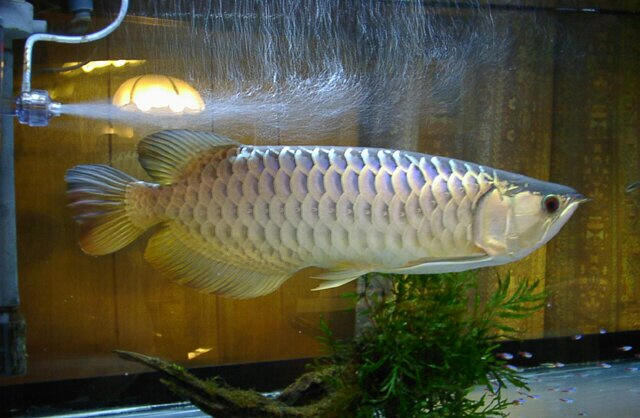
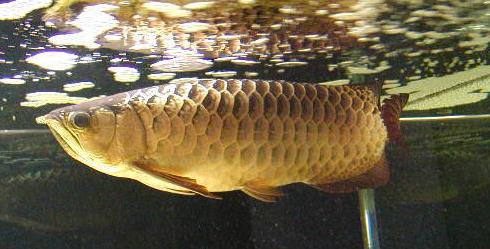
In this family of fishes, the head is bony and the elongate body is covered by large, heavy scales, with a mosaic pattern of canals. The dorsal and the anal fins have soft rays and are long based, while the pectoral and ventral fins are small. The name 'bony tongues' is derived from a toothed bone on the floor of the mouth, the 'tongue', equipped with teeth that bite against teeth on the roof of the mouth.

Habitat/Care:

In the wild, the Arowanas prefers to stay in shallow waters (above five feet deep), near riverbanks and in shaded areas. Arowanas prefer these areas not because they are avoiding the elements, but because insects are plentiful in shaded areas and these are their main source of food.

Mixing with other fishes:

Medium to Large bottom feeders are ideal tank mates for the Arowana. The Arowana will leave these bottom feeders alone. Other peaceful large fish may be safety kept with Arowana. Take care not to include fin-nippers with the Arowana. Smaller fish that will fit into the Arowana mouth will be eaten.

Arowanas are generally highly territorial and will not tolerate another Arowana in a small tank. In a large open pond, however, it has been noted that several Arowanas can be safety kept together. Wikipedia recommends that 5-6 Arowanas should be kept together in a tank instead of 2-3 as when in a group, their aggressiveness tends to be subdued.

Diet:

Arowana prefer live food or at the very least floating food. They will generally not eat from the bottom of the tank. To this end keeping your Arowana with a suitable bottom feeder may be a good idea.

These foods can include: worms, crickets, grasshoppers, locus, fly, small frogs, small fish (limited quantities) and shrimps with shells. Some Arowana may take floating fish food.


Some foods help to promote a good colour in your fish. Prawns contain cerotine which helps bring out the red and gold colours of the Arowana fish. It is recommended however to maintain a varied and balanced diet for any Arowana Fish.

Feeding patterns effect both size and colour of your Arowana Fish. Over feeding can make your fish grow faster however this may adversely affect both colour and long term health of the fish. Since the size, colour and health of your fish are all very important, you are advised not to regularly overfeed any Arowana Fish.


Folklore:

For the Chinese, the dragon is a symbol of good luck and prosperity. In the eyes of the Chinese, the dragon fish has the appearance and majesty of the Chinese Dragon, especially the scales - it resembles the scales of a Dragon.

When a Chinese businessman purchased one of these fishes, then strike a big fortune, the rumor mills were working overtime that he attribute his good luck to owning one of these fish. Soon, demand for this fish rocketed as many others hope that keeping a dragon fish will bring them luck.

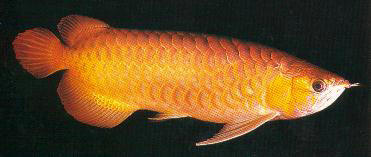
There are 3 types of Asian Arowana - the Red, Gold and Green. For the Chinese, Red is a lucky color, as evidenced by the large amount of red used during Chinese New Year. This makes the Red dragon fish in high demand, and prices for a good quality red can easily fetch around SG$8,888/=. Gold is also considered lucky. However, it is surprising that Green variety is not very popular and is consider unlucky, especially in Cantonese speaking countries like Hong Kong, Shenzhen and Guangzhou. The Cantonese who keep a green Arowana in their home and often gamble are said to "shee tou meen cheang cheang" (lost till their faces turn green).

Breeding:

Between 30 to 40 Arowanas between the ages of five and seven, half of them male, half of them female were released in a pond. They were left in the pond to allow them to pair themselves off, while the fish farmers observed from afar with binocular.

After sometime (between one and six months): compatible male and female Arowanas couple by themselves. However, this does not mean that with 30 to 40 Arowanas, you will see 15 to 20 pairs. On the contrary, it is sometimes impossible to get even one pair.

The farmers continued to keep a close watch on the pair. The males are mouth brooders, and will keep the eggs and fry in the mouth. Sometime later, the male was seen releasing young Arowanas from his mouth for between three and five minutes before drawing them back into his mouth again. At this stage, a net was dropped into the pond to segregate the couple and their young from the other Arowanas. After the young were free-swimming, they were netted and kept in separate tanks to grown individually, feeding on bloodworms.

Observations have shown that the female Arowana spawns once a year and each successful spawn produces between 30 and 80 young.

Illness:

Basically, the Arowana is a very hardy fish; even for first time fish owners. However, due to unsuitable water conditions, poor diet, high nitrate levels, etc., illnesses like bulging eye, cloudy eye, gillc-urling, external parasites, fin rot, dropsy and internal bleeding may occur. Watch out for the last two symptoms as they are likely to be fatal.

In all cases, raise the water temperature to 34 degree Celsius and add about 0.03% salt to the water (i.e. 300g of salt for 100litres of water). It is often helpful to add a wide spectrum medicine with anti-bacterial or anti-parasitic compounds. Medicines like tetracycline, acfriflavine may also help.

One point to note: do not be too concerned over fin rot caused by fighting. Even in cases where extensive damage to the whole tail has been done, the recovery period is only a matter of weeks.

Variants:

  • Asian Arowana - are the most expensive of all because they are near-extinct . They are protected species and mainly from Thailand , Sumatra and Malaysia . Asian Arowana have three main colors - Red , Gold and Green.
  • Australia Arowana - originated from Australia and they look similar to Asian Arowana . Australia Arowana got two types - Pearl and Spotted Arowana . Both looked the same except for the scales and colors. There are even Red or Gold Pearl Arowana.
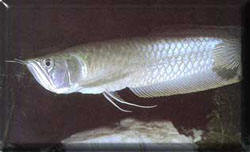
  • Silver Arowana - is the most common Arowana. It is also the cheapest. Silver Arowana have long fin and tail with its whole body silver in color. It can grow up to a very large size about 49 inches!
  • Black Arowana - is the same as Silver Arowana but its fin and tail are black-color. Black Arowana are harder to raise than Silver Arowana.

Photo Galley

Got a photo? Contact me.


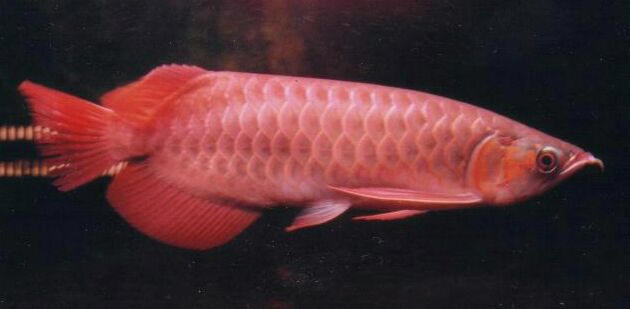
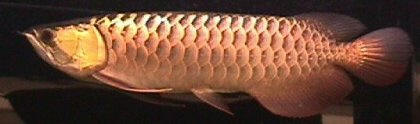
A superb red arowana

Gold, blue scales

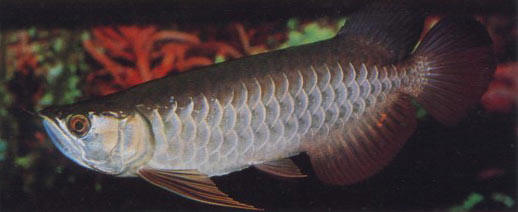
A Gold Arowana with black scales

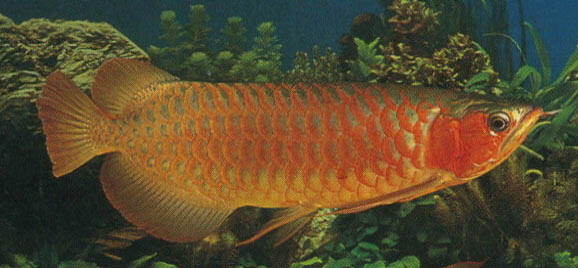
Super Shiny Gold Arowana

Red Arowana

Gold Arowana

Links to other awesome Arowana sites:

1. http://www2.wbs.ne.jp/~arowana/egallery.htm Awesome Photo Galley of Arowana kept by Japanese
2. http://www.luckytropical.com/english/arowana.asp?cat=Red%20Tail%20Arowana&pgno=1&lang=en Another good photo galley.
3. http://arowanaclub.com/gallery/ Amazing collection of Arowana photos.

References Cited:

1. K.K.P Lim & P.K.L Ng, 2000, A Guide to the Freshwater Fishes of Singapore, Singapore Science Center.
2. Billy Lim, 1999, Types of Arowana, [Online], Available http://web.singnet.com.sg/~lin1629/Types.html
3. Dragon Fish Industry, [Online], Available http://dragonfish.com/
4. Arowana Dragon Fish feeding Information, [Online], Available http://www.arowana.co.uk/feeding-arowana.htm
5. Arowana General Care [Online], Available, http://www.aquariumhobbyist.com/ozarowana/care.html
6. Silver arowana - Wikipedia [Online], Available http://en.wikipedia.org/wiki/Silver_arowana
7. Arowana Breeding [Online], Available http://arowana8.tripod.com/Arowana/breeding.html

21 comments:

Anonymous said...

Hi there ! Cool Blog, Be sure to check out my blog about tropical fish

RezzeR said...

Really neat. This is useful and alot detailed. (Added on favorites)

MARTIN said...

Hi,anyone out there, can please tell me where to buy red or golden small arowana (6 inch or less), no more than $150? I know it ridiculus but because of finance problem, and I love arowana so much. Alwas dreaming to have one. If anyone have any lobang, please sms me or call me at this number : 96955678.
Regards!
Martun

richard said...

HALLO SPECIALIST CAN ANY BODY TELL ME HOW TO BUY A GOOD & HEALTHY LOOKING GOLDEN AROWANA.

Anonymous said...

allo specialsit , need your help and information, to get a real golden arowana, hp, 0125053231mines

Anonymous said...

hi there can any one help me

Yu-Jin Lim said...

Hi Richard and all who wanna buy an arowana.

Qian Hu have some Dragon Fish for sale, but it is not cheap. They do export overseas.

See:
http://aquariumlore.blogspot.com/2006/06/jinjin-and-sasa-adventure-in-qian-hu_20.html

you need to go to their website. www.qianhu.com to order from them

Hope this information is useful

Eugene

Vic said...

Love the Arowana fish, can I keep them in 300 Litre Tank and how many.

Anonymous said...

Hallo eugene, thanks ,

Anonymous said...

Hi there, where can I get the statistic or information on the observation that arrowana spawn once a year?

Anonymous said...

Can anyone tell me where to buy gold &super red asian arowana for afair price my contact mob:0411194030

Yu-Jin Lim said...

Please contact Qian Hu http://www.qianhu.com/

Anonymous said...

Any One want to buy any kind of fish please just contact me @ prithvi211297@gmail.com.I may be able to cater to yar needs.
Nice Blog by the way......

Bernice Trivers Ohio said...

i am buy my gold and red from beautyasianfish.com
they shipped to Ohio only 5 days after my payment complete

i will post my arowana in youtube next days hahaha

cause now still wait the aro get back health from stress :)

Alexgan said...

Thanks for the cool blog...
Now,I know how to care for my Arowana fish when I have 1.This can also convince my parents to buy 1 for me.The point is, tanks for the blog...

Alexgan said...

Thanks for the cool blog.Now, I can convince my parents to buy 1 for me.Anyway, my point is, thanks for the cool blog...

Anonymous said...

hi thr i hav a 6" pearl arowana jus wan to ask u how often do they eat bcz i hav kept around 12 feeding guppies fishes in the tank for him to eat plz reply to me on (vishal_moraies@yahoo.com) plz thanx.

saltwater fish tanks said...

Really useful, nice blog

Anonymous said...

It is not legal to sell Green, Gold Red or Chillies in the U.S.A.

Only the Silver.

Reds must have I.D. with a certification numbers.

Please do not purchase an Arawana unless you have at least a 350 gal tank. Mine is 450 Gal Tank and a filter that can handel 1500 GPH. Do a 25 percent water change every other day. You will need enough water storage for these changes. The Arawana should be for display tank only. No other fish. The Arawana is very very agressive and territorial, other fish will stress the Arawana. Do not use substrate in the Tank. You need to be able to see the Fesis and make sure it is black. Do not feed live fish expecially feeder fish such as Gold Fish. They carry diseases. The Arawana will become stressed and start bitting its tail and damaging the tail fins. Yes you will see Arawanas in 70 Gal tanks with other fish. The fish will have a very short life. I mix my own feed, Beef heart, Liver, Red lettuce and Vitamins. Measure, weighed and blended and put in storage bags. I do not freez the food. This is done daily. I keep enough on hand for 3 days then buy more. My Red Arawana is 12 years old and very happy. The care for these fish are very expensive. I may sound a little strong. I hope so, Think about the commitment then think about some more and then some more.

LuqmanDaFishdude said...

Hey guys and experts out there, I just want to ask where I could purchase a Black Aro in Singapore and would love it to be at least 4inch long and could I know how much it will cost?l
Thanks,
Luqman

Derrick Sylester William said...

hey even i have a golden arowana tat is abt 60 cm long
its anasian golden arowana
its noteating properlt since 3 days as we shifted it had a 2 day journey
so wat should i dooooooooooo
and wat should be the size of the new tank pls help me out
!!!!!!!!!!!!!!!!!!!!!!!!!!:)