
| Data Sheet | | |
| Scientific Name: | Paracheirodon innesi | |
| Other Names: | Neon Tetra | |
| Family: | Characins | |
| Origin: | South America Jungle Stream | |
| Adult Size: | 1-1.5 inches (4 cm) | |
| Social: | Peaceful | |
| Lifespan: | up to 10 years | |
| Tank Level: | mid- bottom dweller | |
| Minimum Tank Size: | 10 gallons | |
| Diet: | Omnivore | |
| Breeding: | Egg layer | |
| Care: | easy-medium | |
| Ideal pH: | 5.8-7.5 | |
| Temperature: | 74-79 F (23-26 C) | |
| Tank setup:
| Neons are best kept in a densely planted tank with subdued light and an ideal temperature of 68-74°F to resemble their native Amazon environment. | |
| Sexing: | Males slimmer, females have a deeper body. | |


|
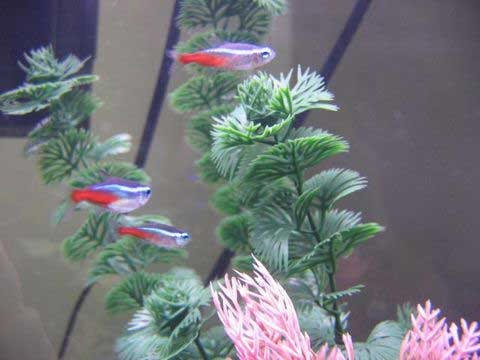
| Description:The neon tetra is light in colour. Starting at about the center of the body, there is a wide bright Red band extending to the start of the Caudal fin. Above this is a Blue band with a green sheen that runs from the upper part of the eye to the Adipose fin. The upper-side is Olive Green and the underside is Silver in color. The Anal fin is milky white to transparent. Habitat/Care:This is an excellent community fish and does very well in large groups. In fact, this fish should only be kept in shoals, or groups of 5 or more fish. Mixing with other fishes:Most bigger fish (even peaceful ones) see neon tetras as delicious food. As such, it is not recommended that it be put in a tank with bigger fish. Fish that mix well with neon tetra in an aquarium are other types of tetras, such as the rummy-nose tetra, cardinal tetra, and glowlight tetra, and other community fish that live well in an ideal Tetra water condition. Diet:Neon Tetras are omnivores and will accept most flake foods, but should also have some small foods such as brine shrimp, daphnia, freeze-dried bloodworms, tubifex, and micro pellet food to supplement their diet. Mid-level feeders, they are best kept in schools of five to eight or more, for the "shoaling" effect when they move around the tank. Their colour and the iridescent stripe may become dim at night, and can be virtually invisible after a period of darkness. |
Breeding:To breed Neon Tetras, place a pair of the species in a breeding tank without any light, and gradually increase the lighting until spawning occurs. Other inducers include mosquito larvae and a hardness of less than 4 degrees. Because the adults will often eat newly-hatched fry, it is best to remove them as soon as they eggs have been laid. Eggs will hatch within 30 hours of the laying. Disease:Neon Tetra Disease -Caused by the sporozoan, Pleistophora hyphessobryconis, the disease is known for its rapid and high mortality rate among neons. To date there is no known cure, the only 'treatment' being the immediate removal of diseased fish to preserve the remaining fish. The disease cycle begins when parasitic spores enter the fish after it consumes infected material, such as the bodies of dead fish, or live food such as tubifex, which may serve as intermediate hosts. Once in the intestinal tract, the newly hatched embryos burrow through the intestinal wall and produce cysts within the muscle tissue. Muscles bearing the cysts begin to die, and the necrotic tissue becomes pale, eventually turning white in color. Symptoms:
Treatment: None, separate or kill diseased fish. There is no known cure. To ensure all fish are not lost, remove diseased fish from the tank. Prevention: | |


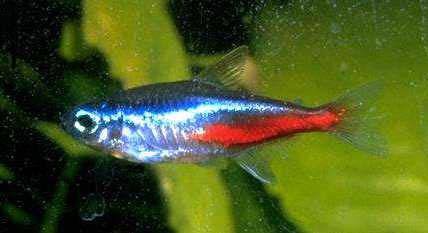

Photo Galley
Got a photo? Contact me.
 | |  |
 | |  |
| | | |
| | | |
References Cited:
1. Aquazia Central - Neon Tetra Info, [Online], Available, http://www.aquariacentral.com/fishinfo/fresh/neon.htm
2. Age of Aquariums - Paracheirodon innesi, [Online], Available http://www.aquahobby.com/gallery/e_neon.php
3. Neon tetra - Wikipedia, the free encyclopaedia, [Online], Available http://en.wikipedia.org/wiki/Neon_tetra
4. Neon tetra, [Online], Available http://www.thetropicaltank.co.uk/Fishindx/tet-neon.htm
5. Bad Man Tropical fish, Paracheirodon innesi, [Online], Available http://badmanstropicalfish.com/profiles/profile17.html
6. Jonathan Lowie 2003, The Neon Tetra, [Online], Available http://www.aquariumhobbyist.com/articles/NeonTetras.html
7. Neon Tetra Disease, [Online], Available http://freshaquarium.about.com/cs/disease/p/neondisease.htm


 Posts
Posts


No comments:
Post a Comment